

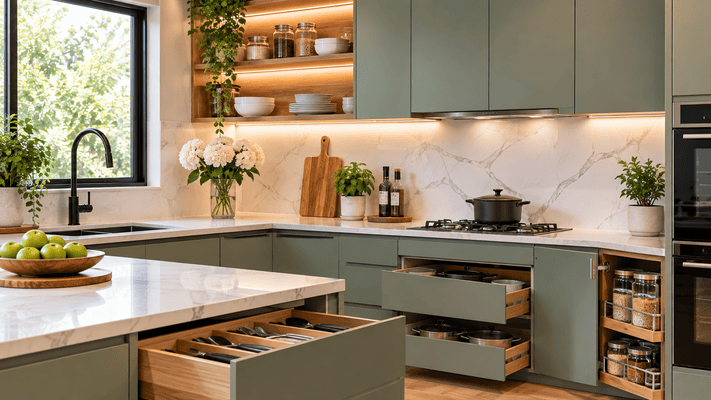
Why a cupboard audit beats choosing door colours first
Pull out the pan you use most and count what has to move first. A baking tray, two lids and a stack of bowls can turn a simple task into a cupboard puzzle. Now look at the drawer you open without thinking. Chances are, its contents have a clear place and come easily to hand. That contrast tells you something useful about your next kitchen. Storage works when it suits the objects inside and the people reaching for them. More cupboards will not necessarily solve an awkward arrangement. Neither will a new colour on the same inconvenient doors. Before looking at finishes, empty troublesome spaces. Sort what you use daily from what comes out at Christmas. The contents are your starting brief.
Imperial Glass and Timber lists drawer units, base cabinets and kitchen storage in standard sizes. When planning custom kitchen cabinets, clarify whether you need made-to-measure joinery or a layout assembled from available modules. Both approaches need accurate measurements and a clear scope. Check what is included before comparing prices. Doors, internal fittings, end panels and installation may be separate decisions. Think about the kettle, chopping boards and lunch containers as carefully as the oven. Give heavy items a place that feels manageable to reach. Include the person who unloads the dishwasher in the planning. A kitchen should fit that job as well as cooking. The useful upgrade is the one you notice with your hands full, when dinner needs starting, and nobody wants to rearrange a cupboard.
How can modern kitchen cabinet designs reduce daily fuss?
Findings from the Australian Bureau of Statistics put daily cooking and food preparation at 1.2 hours for males and 1.3 hours for females in 2024. These averages cover participants aged 15 and over who did that activity. They are not averages for every adult. The figures give everyday kitchen tasks a place in the design discussion.
1. Put the task first
Modern kitchen cabinet designs should support the work you actually do. Keep preparation tools close to a useful work surface. Place frequently used items where the household can reach them comfortably.
2. Measure the contents
Check the height of bottles and the width of trays. Allow for internal fittings that reduce usable space. A cabinet’s outside dimensions do not describe everything it holds.
3. Test the opening
Draw doors and drawers in their open positions. Check for clashes with appliances, walls and neighbouring handles. Imagine someone passing while a drawer is extended.
Give each awkward item a proposed home. Leave spare capacity rather than filling every compartment on paper. Storage needs can change without the kitchen growing.
What kitchen cabinet doors add to minimalist kitchen design
Kitchen cabinet doors give the room much of its visual character. Flat fronts can look quiet, while framed profiles add detail. Compare samples in the room’s actual light. Check how the finish responds to fingerprints and routine cleaning. Minimalist kitchen design still needs places for real belongings. A clear bench is easier to maintain when daily items have accessible storage.
Research highlighted by OzHarvest puts household food waste costs above $1,500 a year. It cites the 2025 Half Eaten report. Its five most-wasted categories are vegetables, leftovers, bakery items, dairy products and meat. These findings concern food habits, not measured benefits from cabinetry. They offer a reason to keep stored food visible and easy to check. Cabinet changes cannot replace meal planning or safe storage.
- Use shelf heights that let you see pantry contents.
- Keep an easy-to-check space for opened dry foods.
- Choose internal layouts you can clean without dismantling the kitchen.
How kitchen handles and knobs work with kitchen drawer runners
Kitchen handles and knobs need to feel right in use. Before ordering kitchen cabinet hardware, try a sample with the people who will use it. Check finger clearance, edges and how firmly you must grip. Match fixing centres carefully if reusing existing holes. Confirm screw lengths suit the door thickness. A pleasing finish cannot compensate for an awkward grasp.
Kitchen drawer runners deserve the same attention as the visible fittings. Ask about rated loads and the complete drawer system they suit. Include the drawer’s own weight when checking the manufacturer’s loading guidance. Full-extension runners can make contents at the back easier to reach. Soft-close describes the closing action, not how much weight a drawer can carry. Check replacement availability before treating two systems as equivalent.
- Test the mechanism with a representative load where possible.
- Confirm adjustment and fitting requirements with the installer.
- Keep model numbers and care instructions with the kitchen paperwork.
What to bring to the conversation before you order cabinets
The most useful kitchen specification says what goes where and how each part works. Door style matters, but so does lifting a casserole dish without shifting half a shelf. Carry that everyday test through the buying process.
Imperial Glass and Timber offers cabinet and handle collections to explore against your brief. Take measurements, photographs and a list of the storage problems you want solved. Ask for the details needed to compare the complete setup, including fittings and installation. Before making the choice, picture filling your cutlery drawer after washing up. If that small job feels simpler in the proposed kitchen, the plan is heading somewhere useful.